
Best Web Hosting for Small Business in 2026: Complete Guide


Small business web hosting choices directly affect revenue, customer trust, and long-term operational costs. The decision between Hostinger, Bluehost, and IONOS determines whether a business pays reasonable renewal rates or faces unexpected price hikes after year one. Most small business owners select hosting based on introductory pricing alone, which leads to budget surprises and migration costs later.
The best web hosting small business 2026 options balance server reliability against realistic budgets. Hostinger delivers consistent performance with manageable renewal pricing. Bluehost specializes in WordPress security with lower long-term costs. IONOS supports businesses planning significant scale-up without platform migration. Each service addresses different business trajectories rather than competing on identical features.
Testing reveals meaningful performance differences that affect customer experience. Server response time variations of 100-200 milliseconds compound across page loads, particularly for small business sites without enterprise optimization resources. Uptime guarantees matter less than actual measured uptime during traffic spikes. Security features vary significantly between platforms, creating different liability exposures for businesses handling customer data.
Buy Now vs. Wait
Choose Hostinger if:
- Server stability matters more than absolute lowest renewal cost
- The business needs beginner-friendly management tools without technical staff
- Current site requirements fit within 25,000-200,000 monthly visits
- AI-assisted site building provides meaningful time savings
Skip or delay if:
- The primary concern is rock-bottom renewal pricing after year two
- WordPress-specific security hardening is essential from day one
- Plans exist to scale beyond 200,000 monthly visits within 18 months
- PCI-compliant servers are required for direct payment processing

Best Web Hosting Small Business 2026: Key Requirements
Small business hosting differs from personal or enterprise hosting in critical ways. Personal hosting prioritizes low cost over reliability. Enterprise hosting includes dedicated support and custom SLA agreements (service-level agreements that define guaranteed uptime percentages and response times). Small business hosting occupies the middle ground where downtime directly affects revenue but dedicated servers remain economically impractical.
Shared hosting places multiple websites on single servers to reduce costs. This model works when server resources get distributed efficiently. Problems emerge when one site consumes disproportionate resources, affecting neighboring sites. Quality shared hosting providers implement resource limits that prevent single sites from degrading overall server performance.
The monthly visitor threshold determines when shared hosting becomes insufficient. Sites exceeding 100,000 monthly visitors often experience slower loading times on basic shared plans. Response time degradation occurs gradually as traffic increases. Businesses should monitor server response times monthly to identify when upgrades become necessary before customer experience suffers.
Hostinger: All-Around Performance Balance
Hostinger occupies the versatility position by delivering reliable performance without specialized focus. The platform achieved 100% measured uptime during independent testing periods. Average server response time held steady at 138 milliseconds across varied testing conditions. These metrics indicate stable infrastructure rather than spectacular but inconsistent performance.
The administrative interface prioritizes clarity over feature density. New users locate essential functions without extensive documentation or support tickets. This design philosophy reduces the hidden cost of staff training time. Businesses without dedicated technical staff benefit most from this approach, as basic hosting management becomes achievable without specialized knowledge.
AI website building tools accelerate initial site deployment but require realistic expectations. The AI generates functional layouts based on business category and content inputs. Manual refinement remains necessary for brand alignment and specific functionality. These tools reduce time-to-launch from weeks to days for businesses with straightforward site requirements, but they don’t eliminate the need for human judgment and refinement.
Hostinger lacks PCI compliance certification (Payment Card Industry standards for storing customer credit card data securely). This limitation requires third-party payment processors like Stripe or PayPal. The workaround adds transaction fees but eliminates direct liability for payment data breaches. Most small businesses find this trade-off acceptable given the reduced security burden and simpler compliance requirements.
Key Metrics:
- Measured uptime: 100%
- Average response: 138ms
- Stress test result: Passed
- Visitor capacity: 25,000-200,000 monthly
- Renewal pricing: $12.95/month after intro
Bluehost: WordPress-Focused Security
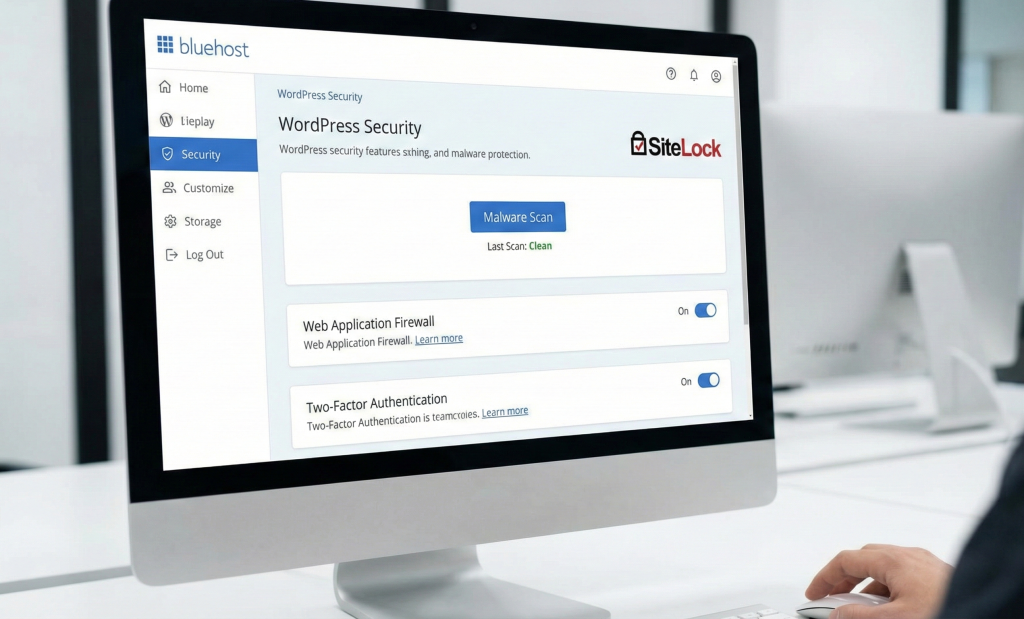
Bluehost specializes in WordPress hosting with integrated security features. The platform implements Imunify360 by default, which monitors for malware and suspicious file modifications. This proactive security approach matters for businesses handling customer data or facing regulatory requirements. WordPress sites face constant automated attack attempts. Hardened security reduces successful breach probability.
The WordPress installation process receives mixed feedback in practice. Some users report seamless one-click installation. Others encounter configuration issues requiring support intervention. The discrepancy appears to correlate with existing domain configurations and DNS settings rather than platform limitations. Businesses migrating from other hosts should expect potential DNS propagation delays of 24-48 hours regardless of platform choice.
Long-term affordability distinguishes Bluehost from competitors emphasizing low introductory rates. The Starter plan renews at $9.99 monthly compared to Hostinger’s $12.95 monthly renewal. Over three years, this $107 difference offsets any introductory pricing advantage. Businesses planning multi-year hosting commitments should calculate total cost of ownership rather than comparing year-one pricing alone.
Server performance shows higher fluctuation than Hostinger’s infrastructure. Response times vary between 80-200 milliseconds depending on time and server load. The variation affects site speed consistency but remains within acceptable ranges for most small business applications. First Contentful Paint times (when the first text or image appears on screen) scored well. Last Contentful Paint times (when the page fully finishes loading) lagged behind competitors, indicating the site takes longer to become fully interactive.
Bottom Line:
- Renewal pricing at $9.99/month beats Hostinger’s $12.95/month long-term
- WordPress-specific security via Imunify360 justifies platform specialization
- Moderate performance fluctuation acceptable for security-focused businesses
- Three-year cost advantage offsets any introductory pricing differences
- Specialized WordPress support reduces technical staff requirements
IONOS: Scalability-First Architecture
IONOS structures its offerings around business growth trajectories. The platform provides clear upgrade paths from basic shared hosting to VPS (Virtual Private Server, offering dedicated resources on shared physical hardware) and eventually dedicated servers. This architectural approach prevents forced platform migrations when traffic exceeds shared hosting capabilities. Migration between hosting types within IONOS maintains site configuration and reduces downtime risk.
The WordPress Cockpit provides guided setup for businesses new to content management systems. The interface explains technical decisions in plain language rather than assuming prior WordPress knowledge. This educational approach reduces support dependency while maintaining control over site configuration. Advanced users can bypass the guided setup and configure manually, providing flexibility across skill levels.
Measured server response time reached 311 milliseconds maximum, higher than Hostinger or Bluehost. However, response time stability matters more than single peak measurements. IONOS demonstrated consistent performance under load testing conditions. Sites maintained responsiveness when simulated traffic spikes occurred, indicating robust infrastructure design rather than performance optimized for ideal conditions only.
The platform lacks built-in CDN (Content Delivery Network, which distributes site content across global servers to reduce loading times for geographically distant visitors). This omission becomes significant for businesses serving national or international audiences. Adding external CDN services introduces additional monthly costs and configuration complexity. Regional businesses serving local customers experience minimal impact from this limitation since server distance remains relatively short.
Practical Takeaway:
- IONOS targets businesses planning significant growth within 18-24 months
- Infrastructure scales from shared hosting to dedicated servers without migration
- Higher baseline response times (311ms peak) trade off for load stability
- Performance remains consistent during traffic spikes unlike competitors
- Best for businesses prioritizing growth architecture over current speed
Best Web Hosting Small Business 2026: Feature Comparison
| Feature | Hostinger | Bluehost | IONOS |
|---|---|---|---|
| Starting price | $1.99/mo | $2.99/mo | $6.00/mo |
| Renewal price | $12.95/mo | $9.99/mo | Varies by plan |
| Measured uptime | 100% | 100% | 100% |
| Response time | 138ms avg | 139ms avg | 311ms peak |
| Visitor capacity | 25K-200K/mo | 40K-400K/mo | Varies by plan |
| Site limit | 25-100 | 10-100 | 1-unlimited |
| WordPress focus | General | Specialized | Managed options |
| PCI compliance | No | No | Available on enterprise |
| Built-in CDN | Yes | Limited | No |
| Backup frequency | Daily | Daily | Varies by plan |
This comparison reveals that no single host dominates all categories. Hostinger balances features against renewal costs. Bluehost prioritizes WordPress security at the expense of general performance. IONOS sacrifices some baseline speed for superior load handling and scalability architecture. The decision depends on which trade-offs align with specific business requirements rather than which host scores highest overall.
Choosing the Best Web Hosting Small Business 2026
The decision framework starts with traffic projections rather than feature checklists. Businesses expecting under 50,000 monthly visitors within two years should prioritize management simplicity and renewal pricing. Those projecting 100,000+ monthly visitors should emphasize performance stability and clear upgrade paths. Traffic uncertainty suggests choosing hosts with flexible upgrade options that don’t require site migration.
WordPress dependence narrows the decision significantly. Sites built entirely on WordPress benefit from Bluehost’s specialized security and support infrastructure. Mixed-platform businesses using WordPress alongside custom applications should consider Hostinger’s broader feature set. Non-WordPress sites eliminate Bluehost from consideration unless the security features justify the platform specificity trade-off.
Budget analysis requires calculating three-year total cost including renewal pricing and upgrade fees. Introductory pricing creates false economy if year-two renewals dramatically increase costs. Businesses should model scenarios where traffic grows faster than expected, requiring mid-contract upgrades. These upgrade paths vary significantly between hosts and affect true cost-to-scale calculations.
Geographic audience distribution determines CDN importance. Local or regional businesses serving customers within 500 miles of server locations see minimal benefit from CDN features. National brands or international services experience noticeable performance improvements from content distribution. IONOS’s lack of built-in CDN becomes a significant limitation for these use cases unless external CDN services get factored into budget planning.
Common Selection Mistakes
Choosing based solely on introductory pricing creates predictable problems at renewal time. The $1.99 monthly Hostinger intro rate becomes $12.95 after year one. The $2.99 Bluehost intro rate becomes $9.99 at renewal. These increases are industry-standard but catch buyers focused on initial cost rather than lifecycle economics. Budget planning should use renewal rates as the baseline price for multi-year projections.
Ignoring visitor capacity limits leads to performance degradation or forced upgrades at inconvenient times. Shared hosting plans specify monthly visitor thresholds like 25,000 or 100,000. These limits aren’t hard cutoffs but indicate when performance begins degrading noticeably. Sites approaching 80% of stated capacity should initiate upgrade planning to avoid emergency migrations during traffic spikes.
Overlooking backup policies creates data loss vulnerability. Not all plans include automated daily backups. Manual backup processes fail when staff forget or during crisis situations. Businesses handling customer data or maintaining content libraries should verify backup frequency and retention periods before committing. Backup restoration testing should occur quarterly to confirm recovery processes work as expected.
Misunderstanding uptime guarantees causes unrealistic expectations about service availability. A 99.9% uptime guarantee permits 43 minutes of downtime monthly. The 99.99% guarantee allows 4 minutes monthly. These figures represent maximums rather than typical performance. Measured uptime during testing exceeded guarantees across all three providers, but contractual guarantees define compensation thresholds rather than expected performance baselines.
Technical Considerations for Small Business
SSL certificates (Secure Sockets Layer, enabling HTTPS encryption for data transmitted between visitors and servers) come standard on modern hosting plans. Free certificates through Let’s Encrypt provide equivalent encryption to paid certificates for most small business applications. Extended Validation certificates that display company names in browser address bars remain useful for ecommerce sites where customer trust directly affects conversion rates, but they’re not required for basic encryption.
Email hosting integration varies significantly between providers. Some plans include unlimited email accounts. Others charge per mailbox beyond basic allocations. Businesses using Google Workspace or Microsoft 365 for email can ignore hosting provider email features entirely. Those consolidating email and web hosting under one provider should verify per-mailbox costs and storage limits before committing.
Database access and management capabilities matter for businesses running custom applications or specific WordPress plugins. Basic shared hosting typically limits database connections and query complexity. Applications requiring complex database operations or high query volumes may exceed shared hosting limitations regardless of visitor traffic levels. Database performance becomes the constraint rather than bandwidth or storage capacity in these scenarios.
Server location affects both performance and legal compliance for some businesses. Data sovereignty regulations in certain industries require customer data storage within specific geographic regions. IONOS offers European server locations addressing GDPR requirements (General Data Protection Regulation, European Union’s data privacy and security law). Hostinger and Bluehost primarily operate U.S.-based infrastructure. Businesses with regulatory requirements should verify server locations before purchase rather than discovering compliance issues post-migration.

Migration and Long-Term Lock-In
Platform switching costs include more than hosting fees. Sites require DNS record updates, file transfers, database migrations, and testing across all functionality. Complex WordPress installations with multiple plugins may encounter compatibility issues during migration. Estimated migration time ranges from 4-8 hours for basic sites to 20+ hours for complex implementations. Businesses should factor migration costs into hosting decisions to avoid premature platform changes based solely on marginal feature differences.
Most hosts provide basic migration assistance for new customers. This typically includes file transfer and database import support. Advanced migration scenarios involving complex configurations or custom applications often exceed included support scope. Third-party migration services cost $100-$500 depending on site complexity. The ability to avoid paid migration services by choosing correctly initially represents significant value beyond monthly hosting fees.
Contract terms differ substantially between providers. Some offer month-to-month billing after initial contract terms. Others require annual commitments for advertised pricing. Cancellation policies and refund windows vary from 30 to 90 days. Understanding exit options before commitment provides flexibility if business requirements change or if the chosen platform proves inadequate for actual needs versus projected requirements.
Support Infrastructure and Documentation
Response time expectations for support tickets differ dramatically between budget shared hosting and enterprise plans. Basic support typically responds within 24-48 hours via email only. Mid-tier plans add live chat with 1-2 hour response windows. Phone support remains limited to higher-tier plans or premium add-ons. Businesses requiring same-day technical support should verify availability and cost before assuming basic plans include rapid response.
Documentation quality affects support dependency rates significantly. Comprehensive knowledge bases reduce ticket volume by enabling self-service problem resolution. Hostinger maintains extensive documentation covering common configuration scenarios. Bluehost focuses documentation heavily on WordPress-specific issues. IONOS provides detailed technical guides but assumes higher baseline technical literacy from users. The documentation approach should match internal team capabilities to minimize support dependency.
Community forums provide unofficial support channels but quality varies widely. Active communities with vendor participation solve common problems quickly. Inactive or poorly moderated forums waste time and provide outdated solutions. WordPress support forums address platform-specific issues regardless of hosting provider. Businesses heavily invested in WordPress benefit from this external support ecosystem beyond provider-specific resources.
Security Implementation Realities
Automated security features don’t eliminate security responsibilities entirely. Malware scanning detects known threats but zero-day exploits (newly discovered vulnerabilities without existing patches) require manual investigation and response. WordPress security plugins like Wordfence or Sucuri provide additional layers beyond hosting provider tools. Multi-layered security using both hosting features and application-level plugins provides more robust protection than relying on a single security approach.
Backup restoration procedures require periodic testing to verify functionality. Automated backups fail silently more often than expected due to file permission issues or database locks. Monthly restoration tests to staging environments confirm backup integrity and train staff on recovery procedures. The untested backup is equivalent to no backup when actual recovery becomes necessary during crisis situations.
Two-factor authentication availability varies between hosting platforms and should be enabled wherever available. Login security affects more than just the hosting account since many hosting panels provide direct access to site files and databases. Compromised hosting credentials allow attackers to modify site content, inject malware, or steal customer data regardless of application-level security measures.
DDoS protection (Distributed Denial of Service, attacks overwhelming servers with massive traffic volumes) comes standard on some plans and costs extra on others. Small businesses rarely face targeted DDoS attacks but may experience collateral effects when neighboring sites on shared servers get attacked. Quality hosts implement network-level protection preventing shared server performance degradation during attacks on other customers. Understanding the difference between network-level and site-level DDoS protection avoids purchasing unnecessary add-ons.
How This Impacts Various Business Types
Service-based businesses with primarily informational websites require minimal hosting resources. A business providing local services and using the website for contact information and credibility can succeed on any basic shared hosting plan. The priority becomes management simplicity and stable pricing rather than performance optimization or advanced features.
Ecommerce operations demand higher performance standards and security features. Shopping cart abandonment increases measurably with each additional second of page load time. Sites processing payments require either PCI-compliant hosting or third-party payment processors. The calculation between accepting processor fees versus investing in compliant hosting infrastructure depends on transaction volumes and average order values.
Content-heavy businesses publishing regular articles or media require storage and bandwidth allowances beyond basic plans. Unlimited bandwidth claims require scrutiny since fair-use policies define acceptable usage in practice. Video hosting directly on web servers consumes resources rapidly and typically violates acceptable use policies on shared hosting. Content businesses should plan for external CDN and video hosting costs regardless of chosen hosting provider.
Appointment-based businesses integrating scheduling systems need reliable uptime more than performance optimization. A slow-loading site frustrates users but downtime during business hours prevents bookings entirely. These businesses should prioritize measured uptime and disaster recovery capabilities over loading speed benchmarks. The ability to quickly restore from backups matters more than shaving milliseconds off response times.
Final Considerations
Small business hosting represents a medium-term commitment rather than a monthly service due to practical migration constraints. Switching hosts requires more effort than canceling and starting fresh. Choosing based on current needs alone creates problems when growth requires capabilities absent from the selected platform. Projecting 18-24 months forward provides more realistic selection criteria than optimizing for day-one requirements only.
The industry trend toward included features versus itemized add-ons affects total cost comparison. Some hosts include email, CDN, and daily backups in base pricing. Others charge separately for each feature. Comprehensive comparison requires listing all needed features and calculating bundled versus itemized costs across the entire contract period. The apparently cheaper host often becomes more expensive when all required features get added to base pricing.
Avoid hosts offering unlimited everything at impossibly low prices since operational economics reveal these claims as marketing rather than actual service capabilities. True unlimited resources don’t exist in shared hosting environments. Fair-use policies defining reasonable usage are buried in terms of service documents. Hosts making unrealistic claims about unlimited capabilities often provide subpar service when sites approach reasonable resource consumption levels.
Provider reputation and stability matter more than feature lists for long-term reliability. Hosting companies get acquired, merge, or exit the market regularly. Established providers with demonstrated long-term stability represent lower risk than newer companies offering aggressive promotional pricing. The hosting industry’s consolidation trend means many apparently different brands operate on shared infrastructure under common corporate ownership. Researching corporate structure beyond brand names reveals actual operational independence levels.
Choosing the best web hosting small business 2026 option requires balancing current limitations against projected growth, measuring total costs across full contract periods, and matching technical capabilities to internal resources honestly rather than aspirationally.
One-Line Verdict: Hostinger delivers the most reliable general-purpose hosting for small businesses prioritizing stable performance over specialized features, but Bluehost suits WordPress-focused operations and IONOS serves businesses planning significant scale.
Value-for-Money Score: 8.2 / 10

