
Bluehost vs SiteGround 2026: Which Hosting Is Right for You?

Both Bluehost and SiteGround power millions of WordPress sites, but their pricing models, bandwidth policies, and support structures differ significantly. The Bluehost vs SiteGround 2026 comparison comes down to whether you prioritize upfront cost savings with traffic restrictions or slightly higher base pricing with unmetered bandwidth and scalable hosting options.
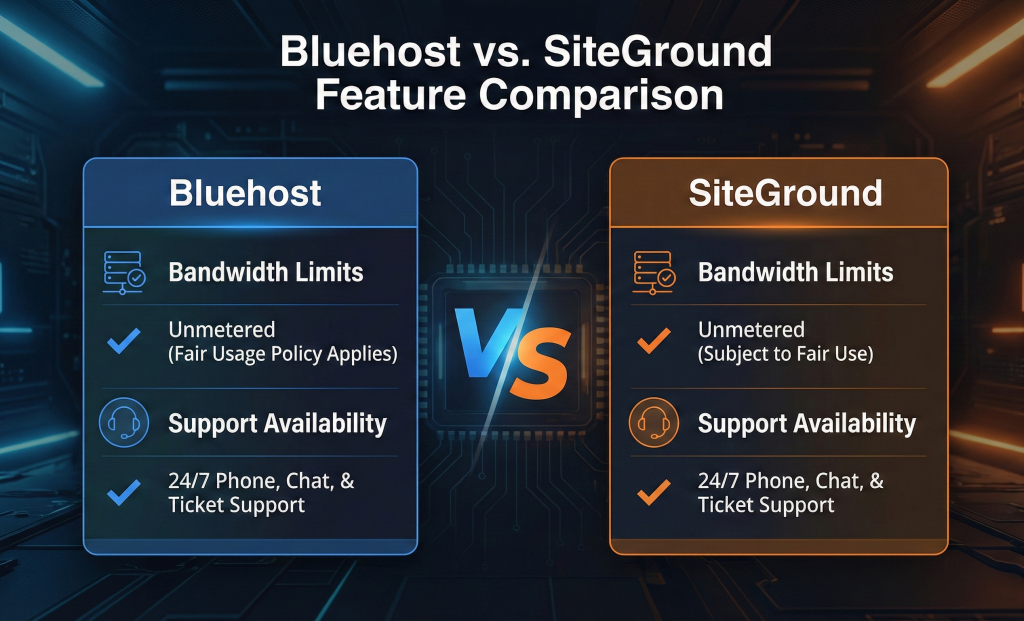
Bluehost offers a free domain for 12 months, unmetered bandwidth, and 24/7 phone support, but renewal rates increase after year one. SiteGround enforces monthly visitor caps, charges for domains from day one, and restricts phone support to sales inquiries. Both provide managed WordPress hosting, free SSL, and beginner-friendly dashboards, though SiteGround’s pricing jumps more sharply at renewal.
Choose Based On:
Bluehost fits users who expect traffic growth beyond 10,000 monthly visits, need VPS or dedicated server options, or want phone support for technical issues. It works best for small businesses scaling across multiple sites or eCommerce stores with unpredictable traffic spikes.
SiteGround suits low-traffic blogs, single-site projects, or users comfortable with chat-only support who don’t mind paying separately for domain registration. Its Google Cloud infrastructure may appeal to users prioritizing uptime over bandwidth flexibility.
Table of Contents
Pricing: Where Costs Diverge After Year One
Both providers offer competitive introductory rates, but long-term costs differ. Bluehost’s shared hosting starts at $3.99/month for 12-month plans, renewing at $9.99/month. SiteGround’s entry plan also begins at $3.99/month but renews at $17.99/month—an 80% increase compared to Bluehost’s 60% jump.
Domain costs add another layer. Bluehost includes a free domain for the first year across all annual plans. SiteGround charges $17.99 upfront, then $19.99 annually for .com domains. Over two years, this adds $37.98 to SiteGround’s total cost before hosting fees.

Bandwidth policies create operational differences. Bluehost provides unmetered bandwidth on all shared and WordPress plans, meaning traffic spikes during sales or viral content won’t trigger overage fees. SiteGround limits the StartUp plan to roughly 10,000 monthly visits—approximately 330 daily visitors—before requiring a plan upgrade.
For WordPress hosting specifically, Bluehost’s mid-tier plan supports 5 sites with 40 GB storage at $6.95/month (renews at $11.99). SiteGround’s comparable GrowBig plan allows unlimited sites but caps storage at 20 GB and costs $7.99/month (renews at $29.99). The storage difference matters for media-heavy sites or WooCommerce stores with large product catalogs.
Feature Comparison: Support, Tools, and Infrastructure
Bluehost provides 24/7 phone and live chat support in multiple languages. SiteGround offers 24/7 chat and ticket support but reserves phone access primarily for billing and sales. Priority phone support exists for higher-tier plans, though response times vary.
Control panel design differs between providers. Bluehost uses a custom dashboard integrating site management, marketplace access, and marketing tools in one interface. SiteGround’s Site Tools panel emphasizes caching controls and Cloudflare integration but requires more navigation for domain or email management.
Both include free SSL certificates and one-click WordPress installation. Bluehost bundles WonderSuite, a guided website builder with pre-configured themes. SiteGround relies on WordPress directly or integrates Weebly, requiring more manual setup for beginners.
Email hosting shows clear differences. Bluehost offers Professional Email at $1.67/month with 10 GB storage, spam filtering, and calendar integration. Google Workspace integration starts at $3.50/month for teams needing collaborative tools. SiteGround includes 10 GB email accounts at no additional cost, though free email tied to shared servers carries higher spam blacklist risk.
| Decision Factor | Bluehost | SiteGround |
|---|---|---|
| Free domain | First year included | None—$17.99 upfront |
| Bandwidth model | Unmetered | Visitor caps (10,000/month entry plan) |
| Phone support | 24/7 all plans | Sales/billing only; priority for high tiers |
| Storage (entry WordPress) | 10 GB NVMe | 10 GB |
| Renewal price increase | ~60% average | ~80% average |
| Email hosting | Paid ($1.67/mo minimum) | Included (10 GB, shared server risk) |
Hosting Plan Availability: Scalability Paths
Bluehost offers shared, WordPress, WooCommerce, VPS, dedicated, and cloud hosting. SiteGround provides shared, WordPress, and cloud hosting but does not offer VPS or dedicated server options.
For sites outgrowing shared hosting, Bluehost’s VPS plans start at $46.99/month with 2 vCPU cores, 4 GB RAM, and 100 GB NVMe storage. The dedicated hosting tier begins at $141.19/month with 8 CPU cores, 32 GB RAM, and 1,000 GB NVMe storage. These options support high-traffic sites requiring isolated server resources or custom configurations.
SiteGround’s cloud hosting starts at $100/month with 8 GB RAM and 40 GB storage, targeting users needing managed scalability without VPS complexity. However, bandwidth remains capped at 5 TB monthly—a restriction that could affect content-heavy sites or streaming platforms.
WooCommerce users face different feature sets. Bluehost’s WooCommerce plans start at $9.95/month and include gift cards, wishlist functionality, and optimized themes. SiteGround pre-installs WooCommerce but lacks dedicated eCommerce features, requiring manual plugin configuration for advanced store functions.
Who Each Provider Actually Serves
Bluehost fits small businesses expecting growth, developers managing multiple client sites, or eCommerce stores with seasonal traffic swings. The unmetered bandwidth model prevents unexpected costs during product launches or marketing campaigns. VPS and dedicated options provide migration paths without changing providers.
SiteGround works for bloggers with consistent low traffic, single-site portfolio projects, or users prioritizing Google Cloud infrastructure over bandwidth flexibility. The platform suits WordPress-focused users comfortable with chat support and willing to pay domain costs separately.
Observed usage patterns suggest Bluehost users value predictable scaling and phone support access, while SiteGround users prioritize uptime and managed WordPress optimization. Neither provider excels at high-traffic enterprise hosting—both eventually require migration to specialized infrastructure beyond 100,000 monthly visitors.
Technical Considerations: Server Architecture and Performance
Bluehost recently upgraded infrastructure to AMD EPYC 9534 CPUs with DDR5 RAM and PCIe 5.0 NVMe storage. These specifications improve disk I/O performance for database-heavy WordPress sites and reduce latency for WooCommerce checkout processes.
SiteGround migrated to Google Cloud Platform, distributing sites across global data centers with automatic failover. This architecture supports 99.9% uptime guarantees but introduces visitor limits as a cost control mechanism. The single database option per site works for standard WordPress installs but restricts users running multisite networks or staging environments.
Both providers include Cloudflare CDN integration, though implementation differs. Bluehost enables CDN through dashboard toggles with minimal configuration. SiteGround requires manual Cloudflare account setup and DNS configuration, adding complexity for non-technical users.

Limitations Neither Provider Highlights
Bluehost’s unmetered bandwidth still enforces acceptable use policies. Sites consuming excessive CPU resources or generating sustained high traffic may receive upgrade prompts or throttling notices. The terms of service prohibit resource-intensive applications like video hosting or cryptocurrency mining.
SiteGround’s visitor caps create hard limits. Exceeding 10,000 monthly visits on the StartUp plan requires immediate upgrade to GrowBig ($29.99/month at renewal) or site suspension. The company does not offer overage billing—users must proactively monitor traffic to avoid downtime.
Email reliability differences stem from infrastructure choices. Bluehost’s paid Professional Email uses isolated servers with reputation management, reducing deliverability issues. SiteGround’s free email shares IP addresses with other accounts, risking blacklist association if another user sends spam.
Verdict: Bluehost delivers better long-term value for growing sites needing bandwidth flexibility and phone support, while SiteGround serves low-traffic projects willing to accept renewal premium for Google Cloud infrastructure.
Value-for-Money Score: 7.2/10